Secret Santa rules: how it works, what to spend, keeping it secret
Every Secret Santa I have seen go wrong broke one of four things: the budget was vague, the names were drawn too late, the list of pairs leaked, or someone dropped out and nobody had a plan. Get those four right and the rest is wrapping paper.
How Secret Santa works
Everyone in the group draws one name and buys one present for that person, within an agreed budget, without saying who they drew. On the exchange day the presents are handed out, and the givers either stay anonymous or own up, depending on the group.
Three rules hold it together:
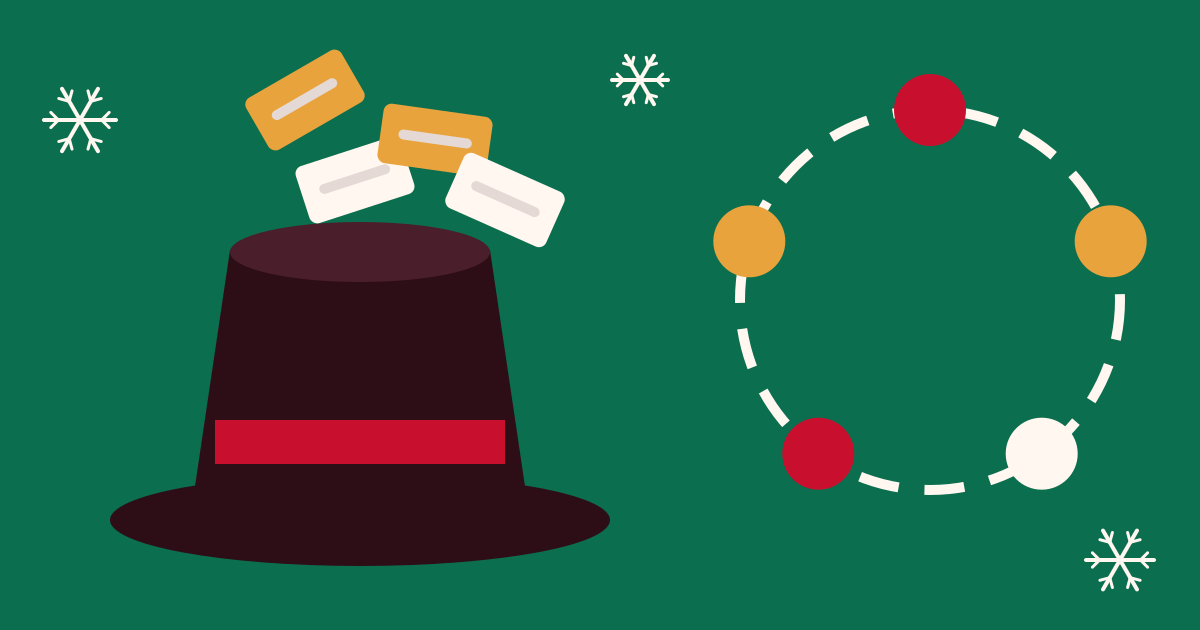
- One gift each way. Every person gives exactly once and receives exactly once. That makes it a chain (Anna buys for Ben, Ben for Chloe, and so on back to Anna), not a set of pairs, which is why an odd number of people works fine.
- Nobody draws themselves or their partner. Couples buy for each other anyway, so most groups exclude them.
- Each person knows only their own match. Not the organiser, not the group chat.
The Secret Santa generator handles all three: you list the names, add exclusions, press Draw names, and each person gets a private link, a turn with the phone or a printed slip.
How much to spend on Secret Santa
Pick one number, not a range. "$20 to $30" turns into an awkward evening where one person opens a $30 gift and another a $20 one. "$25" means everyone aims at the same target, and spending a little under is fine. Put the number in the invitation before anyone draws a name, so nobody feels ambushed after seeing who they got.
giftlist's rules for gift exchanges quotes typical budgets of about $20 to $50, and $25 to $40 for offices. In practice I set it lower for groups where money is tight or attendance is semi-compulsory. Below are the starting points I use; adjust them to your group and currency.
| Group | Budget I'd start with | What makes it work |
|---|---|---|
| Office or team, opt-in | $15–$25 | Low enough that nobody joins under pressure; same number for managers and juniors |
| Friends or flatmates | $20–$30 | Agree in the group chat before the draw; wish-list hints matter more than the amount |
| Adult family | $25–$50 | Replaces buying for everyone; exclude couples and parent–child pairs |
| Kids in a class or club | $5–$10 | A fixed small amount the parents agree on; printed slips work better than links |
| Large family, remote | $20–$30 plus shipping | Say whether postage counts towards the budget (I say it doesn't) |
Enter the amount in Budget and pick the Currency; it then appears on every link and slip, so nobody can claim they didn't know.
Dates and deadlines
Choose the exchange day first and work backwards. giftlist suggests starting three to four weeks ahead, and that matches my experience: under two weeks and someone ends up buying at a petrol station.
- Four weeks out: send the invitation with the budget, the exchange date and the opt-in question.
- Three to four weeks out: draw names and send the links. Fill in Gift exchange date so it shows with every match.
- One to two weeks out: a buy-by date for anyone posting gifts, earlier if parcels cross borders.
- One week out: one friendly reminder in the group chat, without naming anyone.
- Exchange day: hand out the presents and decide whether givers reveal themselves.
Wish lists and hints
A good hint saves the giver an hour of guessing. In the tool each person can have a Wish list or hint (optional) of up to 160 characters, and it travels only to whoever drew them, inside their link or slip. Short and concrete works best: "Dark chocolate, crime novels, size M socks, no candles". Two or three ideas inside the budget beat a list of ten. If someone doesn't fill it in, that is fine too; some people enjoy the surprise.
Keeping the secret
Most leaks come from the organiser or from the group chat, not from the draw.
- Send each link privately. One direct message per person. Never paste the list of links into the group, and never post the pairs.
- If you organise and take part, stay blind. Keep Show all pairs off. If you don't trust yourself, use Pass the phone or Print slips, where each person reveals their own match and you never see it.
- Don't fish in public. Asking "Does anyone know Dev's shoe size?" in the group chat gives you away. Ask Dev's partner privately, or rely on the hint.
- Disguise the gift. Shop-printed labels, no handwriting, and the recipient's name only on the tag.
- Use four or more people. With three, there are only two possible draws, so everyone can work out the whole chain from their own match.
Dropouts and late joiners
People drop out. Plan for it before it happens:
- Before anyone has shopped: remove the person, press Draw again and send everyone a new link. Links already sent can't be recalled and still show the old match, so say clearly in the group which link counts.
- After people have shopped: don't redraw. If Ella drops out, her Santa simply buys for the person Ella had drawn, and the chain closes again. With Avoid swaps on, that person is never Ella's own Santa, so the shortcut works unless the two are an excluded couple. Somebody has to know both matches to arrange it, so this is a job for an organiser who isn't playing and can check Show all pairs.
- A late joiner: the clean fix is a fresh draw. If shopping has started, the organiser can buy a gift for the newcomer, and the newcomer can buy one for the organiser, outside the chain.
Office Secret Santa: keep it opt-in
At work, make joining genuinely optional, ask privately rather than by a show of hands, and keep the budget at the low end. Agree on the tone of gifts: joke presents that land with friends can land badly with colleagues. For teams split between the office and home, mix the reveal methods: Print slips for people in the building and private links for everyone else, all from the same draw.
Frequently asked
How does Secret Santa work in simple words?
Everyone draws one name, secretly buys that person one present within an agreed budget, and the presents are handed out on an agreed day.
How much should you spend on Secret Santa?
Pick one fixed amount everyone can afford. Typical guides quote $20 to $50, and offices often go lower; the amount matters less than everyone aiming at the same number.
When should you draw names?
Three to four weeks before the exchange, earlier if gifts have to be posted. That leaves time to shop, wrap and ship without panic.
What if someone finds out who their Santa is?
Carry on as normal; the exchange still works. Just ask them not to spread it, and make sure the leak didn't come from a shared list of links.